Fishing Gear Sellers: How to Scale TikTok Shop Creator Outreach
If you sell fishing gear on TikTok Shop — rods, reels, lures, tackle boxes — you already know the awkward math of your category. The creators who can actually sell your products are a small subset: anglers, outdoors dads, kayak reviewers, tackle-box organizers. Out of millions of TikTok creators, maybe a few thousand fit. And out of those, only some will reply. Marcus, who runs creator partnerships for an 80-SKU tackle brand selling in the US and Southeast Asia, did the math on a whiteboard one Friday: at eight manual messages a day, his two-person team would need eleven weeks to cover last season’s target list. The season would be over first.
The fix was not working faster. It was changing how the volume gets done. This is how a fishing gear team uses the DAMI workspace to run creator outreach in batches instead of one tab at a time.
The Volume Problem in a Niche Category
Fishing gear sits in a strange middle zone on TikTok Shop. The category gets views — bass-fishing content has a devoted audience, and #fishing sits comfortably in the hundreds of millions of views — but the creator pool that can credibly hold up a jig head on camera is thin. A beauty brand can pick from thousands of makeup reviewers in one country alone. A tackle brand cannot.
That imbalance changes what outreach has to look like. In a broad category, being selective is the skill. In fishing, reaching enough of the right people at all is the skill, because the reply rate on any single message is a coin flip. Some anglers film on weekends only. Some took a sponsorship from a competing brand last month. Some just do not check DMs. You cannot control which ones reply. You can only control how many qualified people hear from you this week.
An operator at a tackle brand in Orlando put it plainly: “We stopped counting replies per message and started counting qualified conversations per week. That number only moves if the outreach list moves first.”
That is the argument for bulk outreach in this category — not laziness, but coverage. And coverage only works if the list is worth covering.
Build the List Before the Message
Marcus’s team starts every cycle the same way: they open the DAMI creator library and filter before they write a single word. The library covers more than 8 million creators, which sounds like overkill for fishing — until the filters narrow it down. Category filters pull outdoors and sports creators. Country filters keep the list aligned with where the brand actually ships. Follower range cuts out both the mega accounts that never reply and the brand-new accounts with no sales history. Recent content performance shows who is actually posting shoppable videos, not just hashtags.
For a niche category the filtering step is where the campaign is won. A creator with 60,000 followers who posted three tackle videos last month is worth ten inactive accounts with double the audience. The DAMI filter panel surfaces that difference before a message is spent on it.
The team also mines competitor storefronts. When a rival tackle brand’s TikTok Shop is moving units, the creators posting shoppable content for them are already proven sellers in the exact category. DAMI pulls the creator list behind any storefront, so Marcus’s team starts its cycle with names that have a receipt attached.
A creator partnerships lead at an outdoor gear company in Denver said this single change rebuilt their program: “Our old list was built from who we could find. The new list is built from who already sold something like our product. Same effort, completely different reply rate.”
Batch the First Touch
Once the list is clean, the sending is the easy part — or it should be. In the old workflow it was not: two operators, two inboxes, and a shared spreadsheet that nobody trusted. The same creator got messaged twice, or nobody messaged them at all.
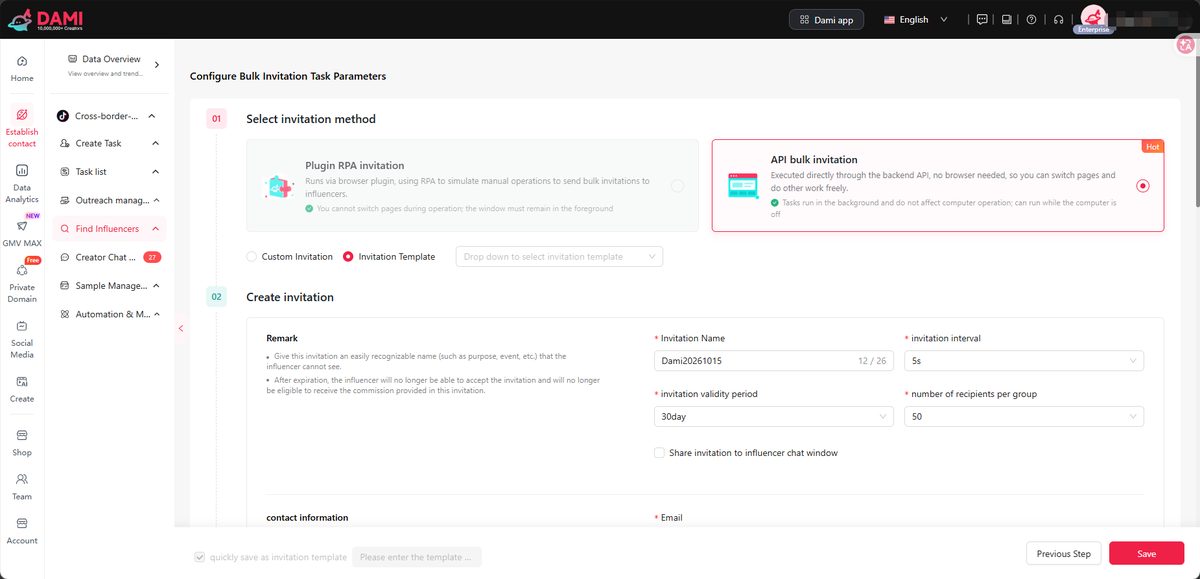
In the DAMI workspace the cycle works differently. The team writes three or four message templates tied to what the brand is pushing that month — a new drop-shot kit, a clearance on last season’s reels, a sample call for a bait launch. Each template references the creator’s recent content, states the commission clearly, and leaves room for the personal line that fishing creators actually read. Then the templates go out as DAMI bulk invitations to the filtered list, all in one pass.
The AI multi-language layer matters more than a US team might expect. A meaningful slice of the world’s fishing-tackle demand is in Southeast Asia — Indonesia, Vietnam, Thailand, Malaysia — and a short, clear first message in the creator’s own language gets answered where a generic English pitch gets archived. The DAMI messaging engine handles the translation across those markets while keeping the tone the team set in the template.
Follow-Ups Without the Manual Chasing
Here is the part most outreach guides skip: fishing creators are often part-time. They film on Saturday, check messages on Sunday, forget by Tuesday. A single first touch quietly dies, and without a follow-up the whole batch was for nothing.
Following up manually does not survive contact with a real week. So the team runs DAMI’s AI-managed follow-up flow in DAMI: the system keeps the thread alive on a schedule, in the creator’s language, without anyone on Marcus’s team remembering who owes a reply to whom. A human still signs off before anything sensitive goes out. The workspace just makes sure nothing falls through the cracks between two busy operators.
The result is that a forty-creator batch keeps moving for two full weeks instead of dying on day one. In a category where reply windows are that slow, the difference compounds. Every month the team does not restart from zero.
Track Which Messages Actually Move
Volume without feedback is just noise. The link-tracking in the DAMI email and messaging flow shows the team which messages got opened, which links got clicked, and which conversations turned into creators who actually posted. Over a season the pattern gets visible: which template angle works for tackle reviewers, which commission rate gets replies in Vietnam versus the US, which day-of-week send performs best for weekend anglers.
That loop is what turns bulk outreach from a bet into a process. The team is not sending more messages every month. They are sending better-targeted ones, because the last batch told them what worked.
A solo seller running a lure brand from Minnesota described the shift: “It felt like shouting into a lake for a year. Now it feels like casting where I know the fish are.”
What the DAMI Workspace Covers for a Tackle Team
For teams evaluating this workflow, here is what is actually in play, in plain terms:
- A creator library of more than 8 million creators with category, country, follower, and content-performance filters
- Competitor and rival-store creator mining, so proven sellers surface first
- Bulk invitations with reusable message templates
- AI multi-language messaging in Thai, Vietnamese, Indonesian, and Malay
- AI-managed follow-up flows that keep threads alive without manual chasing
- Link tracking that shows which messages opened, clicked, and converted
- Sample management for the creators who say yes and need product in hand
- Store data analysis to see which creator posts actually moved units
The point is not any single feature. It is that a two-person tackle team can run the whole loop — list, send, follow up, track, restock samples — from one login instead of six tools and a spreadsheet.
What a Tackle Team’s Batch Week Looks Like
To make the workflow concrete, here is how Marcus’s team runs a typical seven-day cycle inside the DAMI workspace.
On Monday morning they pull last week’s numbers. The DAMI store data view shows which creators posted, which videos moved units, and which offers fell flat. That takes fifteen minutes instead of the hour it used to cost in spreadsheets. The team agrees on the next batch’s angle — a new drop-shot kit, a restock alert, or a sample call for an upcoming bait — and updates the message templates accordingly.
Tuesday is filter day. They open the DAMI creator library, set country to the markets they are shipping into this month, category to outdoors, and follower band to 10,000–80,000. They also pull the rival-store lists for two competitors. By the end of the afternoon they have a clean list of 55 creators, ranked by who looks most active. No one sends a message yet.
Wednesday is send day. The DAMI bulk invitations go out in the morning, in English for the US creators and in the relevant local language for Southeast Asia. The AI-managed follow-up flow starts the same day for creators who do not reply within 48 hours. Marcus’s team spends the rest of Wednesday handling the replies that come back — answering commission questions, confirming sample addresses, and flagging creators who want to talk live instead of email.
Thursday is sample day. Every creator who said yes and confirmed an address flows into DAMI sample management. The warehouse gets a single packing list instead of five separate Slack threads. Each package goes out with a tracked link so the team knows when it lands.
Friday is review day. The DAMI link tracking shows which first messages got opened, which follow-ups earned replies, and which creators are already posting unboxing content. The team adds the week’s winners to a saved list inside the DAMI workspace and archives the non-responders for a future cycle. By Friday evening the loop is ready to start again, with better data than the week before.
A tackle brand operator in Tampa described the rhythm as the real gain: “We are not doing more work. We are just not redoing the same work every week. The workspace keeps the state for us.”

Frequently Asked Questions
Is bulk outreach risky for a small niche like fishing gear? The risk is not in sending in batches — it is in sending to the wrong list. Filter first, batch second. A niche category punishes lazy lists faster than a broad one.
How many creators should a fishing gear team contact per cycle? Most small teams in this category start with 30 to 60 qualified creators per cycle and grow as the tracking data shows which filters produce replies.
Does this work for a solo seller with one store? Yes. The bulk tools are built for exactly the moment when one person can no longer cover the list alone. A solo lure brand runs the same loop with fewer templates.
Can DAMI handle non-English markets for fishing gear? Yes. The AI messaging layer covers Thai, Vietnamese, Indonesian, and Malay, which maps to where a lot of regional tackle demand sits. English markets run on the same templates.
Start Casting Where the Fish Are
If the math on your whiteboard looks like Marcus’s, the DAMI workspace his team uses is open to look at. See how DAMI runs filtered lists and bulk invitations on the product page, or create your account to start building this week’s outreach batch today.