How to Write TikTok Creator Briefs That Convert Using Viral Hooks
You sent thirty samples. Twenty-eight videos came back looking pleasant, competent, and impossible to distinguish from the content that sells nothing. If that number stings, the lesson of how to write creator briefs that convert using viral hooks is that you cannot brief a creator into virality by describing your product better; you brief them into it by encoding the structure of videos that already convert in your category, extracted from the last 30 days of top-performing public content, and then requiring that structure in the first three seconds of every video they make for you.
Most briefs are product documents. They explain features, target audience, and brand tone, then wish the creator luck. The creator, who shoots for six brands a week, defaults to their own format, which is exactly what you would do in their position. The result is content that satisfies the brief and not the buyer, because the brief never specified the one thing that decides whether a video sells: what happens in the first three seconds.
This article gives you the full method. You will define what converting actually means in numbers, learn the five hook structures that dominate TikTok Shop content, see how to reverse-engineer winning videos into a brief template you can reuse across products, and run the iteration loop that sharpens the template batch after batch. By the end, your brief stops being a product sheet and becomes a conversion instrument.
Why Briefs Fail: The Missing Hook Anchor
The failure pattern is consistent enough to be its own genre. A seller writes a thorough brief, covering origin story, ingredient list, and brand values. The creator reads it, nods, and produces a video that opens with a slow pan of the product on a desk. Pleasant music. Feature callouts. A gentle call to action at second twenty-two, by which point most of the audience left at second four.
The problem is not information; it is translation. A brief is a translation layer between what your product does and the grammar of short video, and the grammar of short video is unforgiving about its opening. Viewers grant a new video roughly three seconds before deciding to stay, and every converting video in your category earns those three seconds deliberately, with a hook that creates an open loop the viewer needs closed. Nothing in a feature list produces that loop. Only structure does.
There is a second failure mode worth naming, because mature sellers fall into it more often than newcomers: the over-restrictive brief. Frightened by mediocre results, the seller responds with scripts timed to the half-second, mandatory phrasing, and shot lists, and the creator executes it with the enthusiasm of a hostage. The output converts exactly as well as it deserves to, which is not well, because the creator’s native fluency, the thing you hired them for, never touches the video. The method in this article sits between the two failures: structure is required, execution is free.
A pet supplies seller we will call Jonah experienced both failures in sequence. His first brief campaign was an open invitation: here is the product, here is the brand, make something great. Twenty videos came back, and the two that sold anything happened, by his own admission, to be made by creators who arrived with strong hook instincts of their own. His second attempt was a locked script. Conversion did not move, and two of his better creators declined the next round of samples. The third version, the one that worked, gave every creator the same required opening pattern, a number-shock hook built from his own reverse-engineering work, and near-total freedom after second five. That is the balance the rest of this article builds toward.
What “Converting” Actually Means on TikTok Shop
Before you can brief for conversion, define it, because a brief aimed at an undefined target hits whatever the creator was going to make anyway. For mature sellers running affiliate programs, the working benchmarks based on industry experience look like this: a video worth its sample cost holds viewers to a completion rate around 30 percent or better, moves viewers to add-to-cart at roughly 4 percent or higher, and converts at somewhere above 1.5 percent of viewers. None of these numbers is a law of nature, and category matters enormously, but as orientation points they separate content that is working from content that is merely present.
Notice what is not on the list: view count. Views measure distribution, and distribution is mostly a function of the hook stopping the scroll, which is precisely the thing your brief controls. This is why the hook is not a creative flourish at the top of the brief; it is the highest-leverage component in the entire document, the part that determines whether any of the other parts get experienced at all.
Apply the definitions conditionally. If your goal for a campaign is new-customer awareness for a fresh launch, you weight completion and follow rate, and a softer product reveal can be correct. If your goal is direct sales, and for most affiliate programs it is, you weight add-to-cart and conversion, and the brief should demand commercial hooks, the kind that name the problem and promise the payoff immediately. A single brief cannot optimize both at once, so decide which you are writing before you write it.

One more calibration: judge hooks by retention, not by taste. The video that offends your aesthetic and holds 40 percent completion to the end is outperforming the video you love at 18 percent. Reserve your taste for the parts of the video the brief leaves free, and let the numbers vote on the parts it does not.
Finally, tie the benchmarks to your attribution setup before the campaign starts, not after. Completion and add-to-cart live in the platform’s per-video data, but connecting a specific video to specific sales is your own tracking layer’s job, through per-creator links or codes, and the iteration loop later in this article depends on that connection existing. Decide which videos you will be able to read cleanly before you brief a single creator, because a campaign whose results arrive as an aggregate blur at the end of the month is a campaign that can teach you nothing about hooks, no matter how well it sells. If you are evaluating tools to run this layer, our comparison of the best TikTok affiliate software covers the attribution features that matter most for hook-level iteration.
The 5 Hook Structures That Win for Shop Creators
Across categories, the openings of converting TikTok Shop videos cluster into five structures. Each creates its open loop differently, and each suits different products and viewer states.
Pain-point opener. Name the viewer’s problem in the first sentence, visibly or audibly, so the viewer self-selects in the first two seconds. Works when your product solves a recognizable, recurring annoyance. The hook’s power is identification: people who have the problem cannot scroll past their own problem.
Contrast and comparison. Open with a before-and-after or a this-versus-that frame that promises a visible difference by the end of the video. Works when the result is demonstrable on camera, in skincare, cleaning, haircare, fitness, and home improvement.
Number shock. Lead with a figure that reframes the product’s value: price per use, time saved, quantity, an unexpected statistic. Works when the economics of the product are the story, and especially well in commodity categories where differentiation is quantitative.
Scenario immersion. Drop the viewer into a specific moment where the product matters: the 6 a.m. airport line, the third day of a heatwave, the moment the guests arrive early. Works when usage context drives desire, because the viewer borrows the scenario and feels the need.
Demonstration reveal. Open mid-demonstration on the product doing its most surprising thing, then explain. Works when the product’s core value is visual and surprising, and loses when the reveal is slow to appear.
| Hook structure | First 3 seconds | Best categories | Fails when |
|---|---|---|---|
| Pain-point opener | States the viewer’s problem plainly | Problem-solving gadgets, health, household | The problem is not felt urgently or often |
| Contrast and comparison | Shows the before state or the weaker alternative | Beauty, cleaning, fitness transformations | The difference is not visually dramatic |
| Number shock | Leads with a reframing figure | Value-priced goods, subscriptions, bulk items | The number needs context to land |
| Scenario immersion | Places viewer in a specific lived moment | Seasonal goods, travel, parenting, gifting | The scenario is generic rather than specific |
| Demonstration reveal | Opens on the product mid-action | Novel gadgets, tools, tech accessories | The reveal takes more than 3 seconds to reach |
Two habits make this table useful rather than decorative. First, classify every video you reverse-engineer, and every video your own roster posts, into one of the five, so your data starts carrying structure labels instead of just totals. Second, resist the temptation to declare one structure the winner for your category after a week; hook performance varies by product and by audience mood, and the point of the next section is to let your own category’s recent winners, not a blog post, tell you which structures to demand.
Each structure also carries a writing implication for your brief, and treating them as interchangeable wastes their differences. A pain-point hook lives or dies on the phrasing of the problem, so your brief should supply two or three exact problem statements pulled from your product reviews and comment sections, in the customer’s own words. A contrast hook depends on what the camera can actually show, so the brief’s job is to name the two states precisely and leave the shot design to the creator. A number-shock hook is arithmetic, so the brief must verify the number before it goes on screen, because a misleading figure converts once and then burns the comment section. Scenario hooks need specificity, so write one real scenario in full rather than offering three vague ones. Demonstration hooks are mostly a matter of identifying the product’s single most surprising capability and letting the creator open on it mid-action. The pattern across all five: the brief supplies the substance of the hook, and the creator supplies the performance. When a hook structure consistently produces winners across multiple batches, the content itself becomes a reusable asset, which is why content licensing should be part of your long-term strategy rather than an afterthought.
Reverse-Engineer Briefs From Winning Videos in Your Niche
Here is the core method, and it is unglamorous: build a corpus of the videos that are demonstrably selling in your category right now, extract what their openings have in common, and encode those patterns into your brief as requirements. Thirty to fifty top videos from the last 30 days is enough signal for most categories.
Assemble the corpus from what is publicly observable: the top-selling products’ tagged video sections, category hashtag feeds, and the videos your competitors’ best creators are posting. For each video, record five things on a line: the product, the creator, the hook structure from the five above, what literally happens in the first three seconds, and one note on the caption and comment dynamics. Fifty lines later, patterns emerge that no amount of theorizing would have produced, because you are reading your category’s current taste instead of last year’s playbook.
The extraction step turns the corpus into brief language. Suppose your fifty lines show that a third of the winners open with number-shock hooks on price-per-use framing, and that the demonstration-reveal videos cluster around one specific surprising product capability. Your brief then stops saying “make an engaging opening” and starts saying “open with the price-per-use number on screen and spoken in the first 3 seconds, our research shows this framing dominates the category right now.” The creator receives a requirement grounded in evidence, and the evidence is what earns their compliance, because professional creators recognize homework.
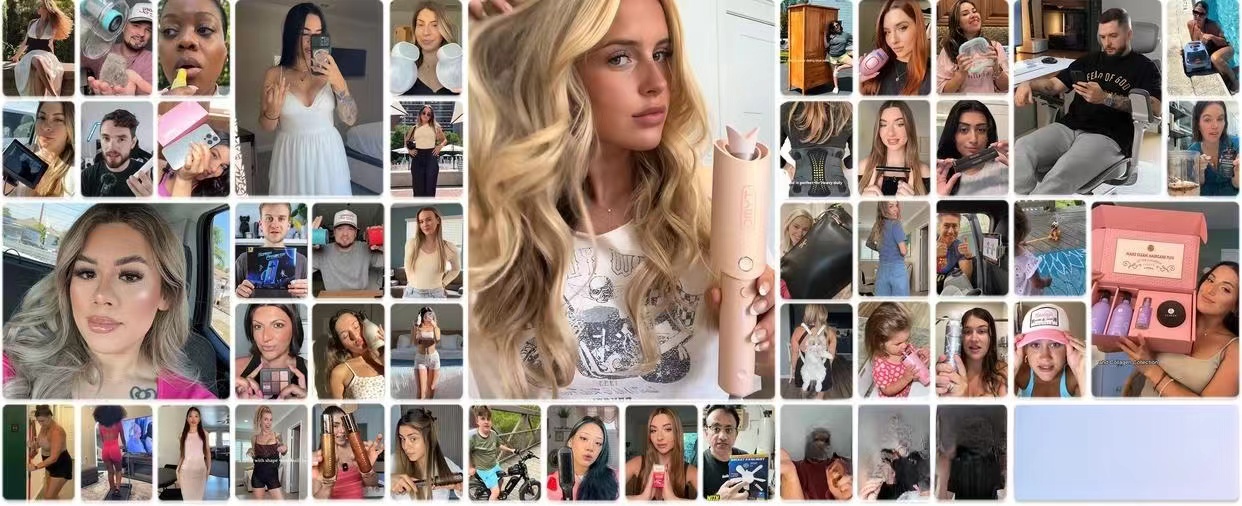
Corpus building is also the most repetitive part of the method, which makes it the part worth tooling. DAMI’s library of more than ten million product videos gives you the raw material to mine winning videos from the 10M+ short video library by category and timeframe instead of scrolling feeds for an evening, and the same material doubles as vetting evidence when you find and vet creators in an 8M+ database, since a creator’s presence inside the winning set is the strongest possible audition. Use DAMI to pull category winners and their creators in one pass, and your reverse-engineering session fits inside an hour.
Refresh the corpus monthly. Hook fatigue is real, categories rotate their favorite structures, and a brief built on January’s winners quietly loses authority by April. The monthly rebuild is also the moment to retire requirements that stopped appearing in new winners, because a requirement that no longer reflects the category is just a constraint wearing the costume of insight.
Walk through one composite example of what extraction produces, because the abstraction is easier than the practice. A skincare seller we will call Vera ran the method on her category’s last 30 days. Her fifty lines showed a clear pattern: contrast hooks dominated the top of the table, but the specific before-and-after framing had shifted from generic skin texture toward a specific, named moment, the morning-after-a-late-night look, and the comments under the winners were full of viewers tagging friends in exactly that situation. Scenario language was bleeding into contrast structure. Her next brief required that specific framing in the opening, quoted three customer comments as tone reference, and attached the two best videos as examples. The batch that followed produced her first videos clearing the add-to-cart benchmark by a wide margin, and nothing about her product, commission, or roster had changed. What changed was that fifty lines of homework replaced a month of guessing.
The corpus also tells you what to ignore, which is nearly as valuable. Vera’s lines showed demonstration-reveal hooks performing near the bottom of her category despite working well in adjacent beauty niches, which saved her from demanding a structure her category’s audience had already voted against. This is the quiet advantage of evidence over instinct: it prevents not only the wrong requirements but also the fashionable ones that happen to be wrong for you. A well-maintained corpus also doubles as an early warning system for product trend shifts, because the hook structures that dominate your category’s top performers change before the sales data does, and a seller who reads the change in the hooks can adjust briefs before the old ones start underperforming.
The Conversion Brief Template
The template below is what the whole method produces. It is deliberately short, because creators do not read long briefs carefully, and each field exists to either transmit structure or prevent a specific, common failure. Copy it, fill it per product, and attach the two or three reference videos from your corpus that best show the required hook in action. This is the point in the workflow where sellers who searched for how to write creator briefs that convert using viral hooks usually wanted the shortcut, and the honest news is that the shortcut is exactly this: a one-page template whose every field was earned by watching fifty videos and counting.
| Field | What to write | Common mistake |
|---|---|---|
| Product positioning | One sentence: what it is, for whom, the single strongest reason to buy | Feature laundry list instead of one sharp claim |
| Target viewer | The specific person and moment, not a demographic label | Everyone aged 18 to 45, which means no one |
| Required hook | The structure, the exact first-3-seconds behavior, and one reference video | Vague asks like make it engaging or be creative |
| Must-avoid list | Claims you cannot support, competitor names, platform-risk phrases | Omitting it and discovering the problems in the comments |
| CTA design | When the product link appears and with what phrasing | Leaving the CTA to creator instinct, which means it never appears |
| Compliance lines | Category-specific claims rules, required disclaimers | Assuming the creator knows your category’s regulations |
| Exclusive information | Launch dates, discount windows, anything not yet public | Spilling schedule details without marking them confidential |
| Sample usage | How many videos, in what window, with what minimum lengths | No stated expectation, so one video arrives whenever |
Notice the template’s quiet theory of the creator. It assumes the creator is a skilled professional who performs better with clear constraints and real evidence than with either total freedom or total scripting. The required hook and CTA fields carry your conversion engineering; everything else exists to keep the creator’s fluency inside safe and useful bounds. Sellers who respect that division report the same pattern: creators begin treating the brief’s reference videos as a collaboration prompt rather than a cage, and the takes get better precisely because the first three seconds are already decided.
See how one field fills in, since the table’s abstraction benefits from a worked example. The required hook field, done properly, reads like this: open on the morning-after-a-late-night problem, stated in the customer’s words from the attached comments, within the first 3 seconds, voice-over or on-screen text both acceptable, reference videos attached, and note that our category’s current top performers use this framing. That single field carries the structure, the evidence, the creative latitude, and the proof of homework, in five sentences a creator can act on while half awake. Compare it with the field it replaced, make an engaging opening that stops the scroll, and you can see the entire difference between a conversion brief and a wish. If the difference is the work you keep postponing, use DAMI to source the winning videos and creator evidence that fill these fields in an afternoon.
Brief Personalization by Creator Tier
The same template scales differently across creator tiers, because what a macro creator needs from you and what a nano creator needs are nearly opposite documents. Send identical briefs to both and you will underserve one and insult the other.
For macro creators, the million-plus tier, the brief is a positioning document with guardrails. These creators convert because of their format and their audience relationship, not because of your instructions, so the brief carries the product claim, the one required hook direction as a request rather than a demand, the compliance lines, and the CTA timing, then gets out of the way. Over-scripting a macro creator buys you one mediocre video and loses the next collaboration.
For the mid tier, tens to hundreds of thousands, the full template applies, hook requirement included. This tier is where most program GMV lives, and it is the tier that benefits most from your reverse-engineering, because these creators have strong production habits and thinner instinct for what converts in your specific category this month.
For nano and micro creators, the brief drifts toward a semi-script: the first three seconds written out almost verbatim, the demonstration beats listed, the CTA phrased exactly. This tier experiments willingly, costs little to sample, and produces the volume you need for iteration, which is why the next section’s loop runs mostly on them.
Tier thinking also solves the scale problem of brief production. Running ten creators can be done with one careful document per product. Running a hundred requires the template plus tier variants, produced in a batch whenever a product enters the program, so that onboarding a new creator means assigning the right variant rather than writing a new brief. At that scale, the discipline of standardized fields stops being bureaucracy and becomes the only thing standing between you and a hundred slightly different versions of the same product story.
Iterate Briefs Based on What Actually Converts
The template is a hypothesis. The iteration loop is what turns it into an asset, and it runs in batches rather than one video at a time, because single videos are too noisy to teach you anything. Everything in this article, the benchmarks, the five structures, the corpus work, the tier variants, exists to serve this loop, because the question of how to write creator briefs that convert using viral hooks never has a final answer: it has a current answer, calibrated to your category this month and quietly expiring until the next refresh renews it.
Structure it like this. Launch the brief against a first batch of roughly five creators, let the content accumulate for two weeks, then read the batch against the benchmarks from earlier: completion, add-to-cart, conversion, classified by hook structure. Whatever structure the data favors becomes the required hook in the next brief version; whatever flopped gets demoted to optional. Launch the revised brief at the next five creators, and repeat. Three or four loops in, most categories converge on one dominant and one secondary hook pattern, and the brief stabilizes into something you genuinely trust, because you watched it earn its authority.
Keep the loop honest with two disciplines. First, change one major variable per loop; if you rewrite the hook, the CTA, and the target viewer simultaneously, the next batch’s numbers cannot tell you which change worked. Second, compare batches against their own baseline, not against each other, because batches differ in creator mix, product maturity, and season. The question each loop answers is narrow and sufficient: given similar creators, did the new structure outperform the old one.
The loop also needs a policy for the creators whose videos underperform the brief, because the temptation after a bad batch is to treat it as a talent problem. It sometimes is. But the more common diagnosis is tier mismatch, a macro creator handed a nano-style semi-script, or a nano creator given positioning and freedom they had no framework to use, and the fix is reassigning the tier variant rather than cutting the creator. A second common diagnosis is hook mismatch with audience: the structure performed well in your corpus, but this creator’s audience sits in a different mood or market. Before the exit conversation, give one creator one revised brief, and read the second attempt before deciding what the first one meant.
Conditional logic closes the loop. If your program is small, under twenty creators, run the loop on your whole roster each time, because the batches are small enough that every video is signal. If you are running a hundred creators across markets, run the loop on a standing test cohort of five to ten nano and micro creators per market, keep the main roster on the currently validated brief, and promote changes only after the cohort confirms them. The test cohort costs almost nothing, because micro creators work for samples, and it converts your program’s brief from an opinion into a maintained instrument.
What the loop produces, if you run it seriously, is a proprietary mapping of your category’s conversion grammar, and that asset compounds across everything downstream. The winning hook patterns inform not just briefs but product selection and even thumbnail and caption choices. And the briefs themselves become inputs beyond live creators: a proven brief structure is exactly the scaffolding you hand to AI video generation when you need volume, so scale product video output without a video team by letting the tested template drive it. When a creator’s video emerges from the loop as a proven winner, the next move is amplification: license winning content for paid amplification rather than letting it decay in the feed, or use Spark Ads to amplify top creator content while the hook is still fresh in the category.
The iteration loop is also where sellers who want shortcuts get burned. The temptation after one good batch is to freeze the brief and mass-deploy it, and it works, for a while, until the category’s taste moves and the frozen brief keeps producing declining results. Treat the monthly corpus refresh and the batch loop as a single ongoing habit, and the brief stays current the way a store’s bestseller list stays current, continuously and without ceremony. Use DAMI to run the whole engine, from mining winners to briefing creators to tracking what converted, and the loop runs on schedule instead of on willpower.
FAQ
How long should a TikTok creator brief be?
One page, or its chat-message equivalent. A brief long enough to cover every contingency is a brief the creator skims, and the fields that matter most, the hook requirement, the CTA timing, and the compliance lines, are exactly the ones that get lost in the skim. Everything nonessential belongs in an attached reference video instead of a paragraph, because creators watch examples far more carefully than they read instructions.
What hook structure converts best for TikTok Shop?
There is no universal winner, which is why the reverse-engineering step exists: the structure that converts best is whichever one dominates your category’s top performers in the last 30 days. Pain-point openers and contrast hooks are the most broadly reliable across categories, while number-shock and demonstration hooks dominate specific niches like value-priced goods and novel gadgets. Let your own corpus make the call for your product, and recheck monthly.
Should I give creators a script or just talking points?
Tier decides. Macro creators get positioning and guardrails with near-total freedom, because their native format is what you are renting. Mid-tier creators get the full structured brief with a required hook and free execution afterward. Nano and micro creators can receive near-scripts, especially for the first three seconds, and generally welcome them. The constant across all three is that the opening structure is specified and the middle is not.
How do I know if my brief is too restrictive?
Watch for two signals. The first is execution quality: videos that follow the brief exactly and feel dead, with no trace of the creator’s personality, mean the brief has crowded out the fluency you are paying for. The second is relationship: capable creators declining your next sample round is a market signal worth more than any dashboard. If either appears, cut the brief back to the hook requirement, the CTA, and the compliance lines, and let the creator fill the rest.
Can I reuse winning briefs across products?
Across products in the same category, yes, and you should: the hook structure and template mechanics transfer, and only the positioning and reference videos change. Across categories, only the method transfers, not the artifacts, because hook performance is category-specific enough that a beauty-winning structure can flop for kitchen goods. Keep a brief library organized by category, and start each new category from a fresh corpus rather than from your most successful template.